

.
Blasting downwind in a stiff breeze (say 25 - 30 kts true) with prevented main and poled headsail, how long would it take you to turn back upwind?
Some old salts with bigger boats reckon it is nigh on impossible to turn back to pick up a MOB in these situations as it would take too long.
With a conventional bermudan you should be able to furl the headsail with the pole still deployed and release the preventer from the cockpit. It normally takes us less than 90 seconds, but it is a relatively small boat. If it is going to take longer than two or three minutes then you are sailing out of control to all intents and purposes. I used to rig pole and preventer so I had to go on deck to release things before turning upwind, but a near miss with another yacht changed my attitude to that many years ago.
I have had to gybe in a close quarters situation with a ship at night on two occasions. A preventer that could not be released from the cockpit could have caused a very tense situation indeed. It is easy to think that once in the open sea rapid course changes are unlikely to be required, but MOB is one example where they may be. I would have thought that if you feel it will take a long time to turn into wind then maybe it might be worthwhile re-examining your downwind sailing habits, whatever size or type of boat you sail. Just saying it can't be done seems a bit defeatist IMO.
So - how long would it take you?
Dangerous downwind sailing practices . . .
-
Magna Carter

- Master Mariner
- Posts: 141
- Joined: Tue Nov 08, 2005 5:51 pm
- Location: East Coast
- Contact:
-
Nick

- Admiral of the Blue
- Posts: 5933
- Joined: Sun May 12, 2002 4:11 pm
- Boat Type: Albin Vega 27 and Morgan Giles 30
- Location: Oban. Scotland
- Contact:
Yes
.
Pole is fixed with 3 lines - uphaul, downhaul and guy (led back to cockpit).
This makes the pole into essentially a fixed spar. Genoa sheet is led through the end of the pole. In seconds you can roll the genoa away, pole stays where it is, no probs.
I can only assume from some of the posts on TOP that people are in the habit of rigging preventers that cannot be released easily and/or poling out headsails in a way that does not allow them to be furled away in a hurry.
If you want to (not quite) stop the boat without releasing the sheets then don't turn into wind, gybe and you sort of heave to downwind with both sails backed, just as if you have had an accidental gybe - which is why the preventer was rigged in the first place. It's not really a good idea though as a deliberate plan, as it is v. difficult to do anything without gybing back and releasing the sheets normally, but could be useful to give yourself a few seconds thinking space if you have gone a bit blank.
Pole is fixed with 3 lines - uphaul, downhaul and guy (led back to cockpit).
This makes the pole into essentially a fixed spar. Genoa sheet is led through the end of the pole. In seconds you can roll the genoa away, pole stays where it is, no probs.
I can only assume from some of the posts on TOP that people are in the habit of rigging preventers that cannot be released easily and/or poling out headsails in a way that does not allow them to be furled away in a hurry.
If you want to (not quite) stop the boat without releasing the sheets then don't turn into wind, gybe and you sort of heave to downwind with both sails backed, just as if you have had an accidental gybe - which is why the preventer was rigged in the first place. It's not really a good idea though as a deliberate plan, as it is v. difficult to do anything without gybing back and releasing the sheets normally, but could be useful to give yourself a few seconds thinking space if you have gone a bit blank.
- Nick 

-
Nick
- Admiral of the Blue
- Posts: 5933
- Joined: Sun May 12, 2002 4:11 pm
- Boat Type: Albin Vega 27 and Morgan Giles 30
- Location: Oban. Scotland
- Contact:
Well . . .
.
A new to sailing forum would be a great idea in some ways, but it woujld get very repetitive. Better perhaps a series of articles on the site to which people can be directed. Anyone wanting to write/contribute to a 'starting sailing' series please get in touch.
In the meantime:
clew - the lower aft corner of a triangular sail (the other two being head and tack).Head is self-evident, being at the top. The tack is where you attach it to the deck and the other corner is the one you don't have a clew about.
cringle Stainless eye in a sail through which lines can be led without causing chafe. Typically there is one at each corner and several for reefing lines on the luff and leech (see below)

preventer Line attached to the boom - usually at the outboard (aft) end - that is then taken forward outside the shrouds to a suitable block and back to the cockpit. The boom is allowed to swing out as far as is possible for downwind running - usually until the sail is just touching the shrouds - then the preventer is tightened up and made fast somewhere accessible from the cockpit. If (unintentionally) the wind gets behind the mainsail, initiating a gybe, then the preventer fetches up against the shrouds and stops the boom swinging all the way across taking heads and gear with it. It is very important that the preventer can be rapidly disengaged from the cockpit, as it is impossible top turn the boat upwind without slackening the preventer line.
Here endeth the lesson for today. Now I expect someone will argue with me about something . . .
A new to sailing forum would be a great idea in some ways, but it woujld get very repetitive. Better perhaps a series of articles on the site to which people can be directed. Anyone wanting to write/contribute to a 'starting sailing' series please get in touch.
In the meantime:
clew - the lower aft corner of a triangular sail (the other two being head and tack).Head is self-evident, being at the top. The tack is where you attach it to the deck and the other corner is the one you don't have a clew about.
cringle Stainless eye in a sail through which lines can be led without causing chafe. Typically there is one at each corner and several for reefing lines on the luff and leech (see below)
preventer Line attached to the boom - usually at the outboard (aft) end - that is then taken forward outside the shrouds to a suitable block and back to the cockpit. The boom is allowed to swing out as far as is possible for downwind running - usually until the sail is just touching the shrouds - then the preventer is tightened up and made fast somewhere accessible from the cockpit. If (unintentionally) the wind gets behind the mainsail, initiating a gybe, then the preventer fetches up against the shrouds and stops the boom swinging all the way across taking heads and gear with it. It is very important that the preventer can be rapidly disengaged from the cockpit, as it is impossible top turn the boat upwind without slackening the preventer line.
Here endeth the lesson for today. Now I expect someone will argue with me about something . . .
- Nick
Re: Dangerous downwind sailing practices . . .
Well, er, since the boat spun a couple of times in squalls, i suppose i could just turn round, unles at limit of canvas. No pole on cat of course...Nick wrote:.
Blasting downwind in a stiff breeze (say 25 - 30 kts true) with prevented main and poled headsail, how long would it take you to turn back upwind?
Why wd prevented main be an issue? Or am i missing summink? I don't think it impossible to turn upwind with preventer on - it's easy as pie! In emergency, off the wind a bit, yank on topping lift, unlock main, bang, no main and nicely held boom with that preventer? Or are we gonna undo the preventer and haul main? Do we have to put the sail away nicely in the bag with the dodgy zip as well?
MOBwise, unless overcanvassed, i reckon the most important immediate tasks are get a sight fix (by more than one person if poss) and cut any fishing lines.
Anyway, generally, I reckon the most vital thing is to do just *one* transat in company of the previous (singlehander) owner of the boat during which you average 4.5 knots and report that there was one 24 hour period of F7, touching F8, (so presumably all the rest f6 or less) and then bum around in the caribbean for the next four years updating an exhaustive weblog and pontificate from the comfort of a a wifi bar along the lines of "...they say that the E-W transat is the milk run. It isn't" or "We do like strong winds!" or some hardnut-sounding blarney about abandoning any MOB. When in fact, that one and only ocean passage has resulted not in any extra confidence but in owner/crew too rattled to sail the boat back w-e or continue to pacific, and now several weeks if not months each year are spent waiting for weather, meow....
Last edited by tcm on Sat Mar 22, 2008 11:53 am, edited 1 time in total.
-
Nick
- Admiral of the Blue
- Posts: 5933
- Joined: Sun May 12, 2002 4:11 pm
- Boat Type: Albin Vega 27 and Morgan Giles 30
- Location: Oban. Scotland
- Contact:
Do I know them?
Otherwise i reckon the most important thing is to do just *one* transat in company of the previous (singlehander) owner of the boat during which you report just one very scary 24 hour period of F7, touching F8, (so presumably all the rest f6 or less) and then bum around in the caribbean for the next four years updating an exhaustive weblog and pontificate from the comfort of a a wifi bar that "they say that the E-W transat is the milk run. It isn't" or "We do like strong winds" or some other blarney about abandoning any MOB, when in fact the one and only ocean passage has resulted in owner/crew too rattled to bring the boat back or continue to pacific, and several months a year are spent waiting for weather, meow....
Sounds like a classic sailing stereotype - pause points on the circuit / rtw route must be heaving with them. A few have washed up in the Canaries as well. Was a bit worried about pos. becoming one of them if we transponded in FW as I can't afford to be a beach bum in the Caribbee. (Could manage it in the Canaries tho . . . )
- Nick
um no, i meant just release the main halliard once the boom is supported by topping lift. A bloke up the mast had to do this with jammed main halliard dues to knackered sheaves, boat yawing at anchor with sail up and it definitely comes down nice and quick when you chop the main halliard.Nick wrote:Not sure I am quite with you here - where does it go then? Yanking on topping lift scandalises main, what is unlocking it, I can't find the key to ours . . .yank on topping lift, unlock main, bang, no main
Are you talking about in mast reefing or what? Or am I being dense?
-
Nick
- Admiral of the Blue
- Posts: 5933
- Joined: Sun May 12, 2002 4:11 pm
- Boat Type: Albin Vega 27 and Morgan Giles 30
- Location: Oban. Scotland
- Contact:
Ah . . .
.
Do you have lazyjacks, stackpack and a fb main by any chance?
If you did that on our boat the sail would mostly blow over the side in to the water and it would be a dogs dinner. Dropping the main involves getting up on the coachroof and wrestling with it while trying to stay on the boat - not a pleasant experience in big seas. That's one of the reasons we always get rid of the main early when running downwind in big winds.
Do you have lazyjacks, stackpack and a fb main by any chance?
If you did that on our boat the sail would mostly blow over the side in to the water and it would be a dogs dinner. Dropping the main involves getting up on the coachroof and wrestling with it while trying to stay on the boat - not a pleasant experience in big seas. That's one of the reasons we always get rid of the main early when running downwind in big winds.
- Nick
Re: Ah . . .
yep. Kerblam, it comes down fast. Otherwise bit different.Nick wrote:.
Do you have lazyjacks, stackpack and a fb main by any chance?
Still a bit of a dog's dinner with fb main but I imagine that the MOB won't generally get hauled back on board and say "jeez what a mess you have made of the main".
-
Silkie

- Admiral of the Fleet
- Posts: 3475
- Joined: Sat Mar 05, 2005 12:55 pm
- Boat Type: Hurley 22
- Location: Bonnie Scotland
- Contact:
This is an ability which cannot be overvalued...and he is great with the ladies.
We did our Comp Crew as a family when it was everyone's first experience of a yacht. We made sail on the first day in very light airs, the boat heeled infinitesimally and swmbo said "Ooerr!" Cap'n Dave immediately put 2 reefs in and commenced motor-sailing.
On the last day we again had 2 reefs but this time we were going to windward in F5 & 6 without demur. I still cherish this pic of the day in question. Excuse the quality and no, that's not swmbo with the horizontal hair on the pushpit seat.

different colours made of tears
-
Telo
- Admiral of the Red
- Posts: 2505
- Joined: Wed Jan 05, 2005 9:27 pm
- Boat Type: Vancouver 34 Pilot
- Location: Bampotterie-sur-mer
- Contact:
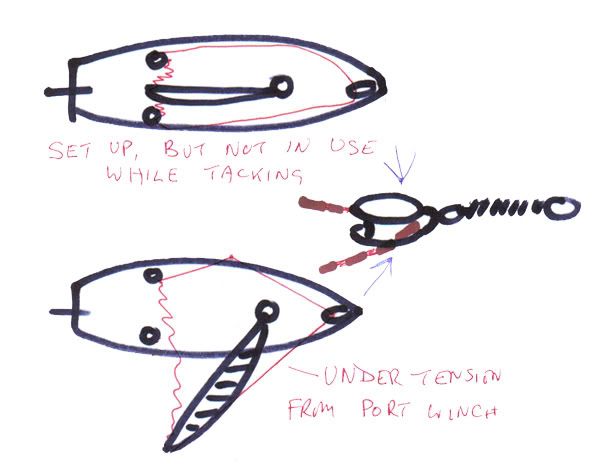
Your question re the preventer
We use a single line for preventing the main - both ends tied to the boom and led round the bow through a block;
-
claymore

- Admiral of the Green
- Posts: 4763
- Joined: Sun Oct 19, 2003 2:55 pm
- Boat Type: Claymore
- Location: Ardfern or Lancashire
We use ths same system as Shard. Claymore doesn't like going upwind in a strong breeze so the person(s) on board would drop the main at the first opportunity (stacpac) and motor back to the MOB. Never done this but I have a notional plan to motor back upwind using the autopilot to steer which allows one to drop the main and be moving in the general direction of the MOB. I have managed to furl the genoa with the pole still attached - this as an experiment, not in anger. As someone else mentioned, I just clip the pole onto the sheet, not though the bowline.
The bottom line on Claymore is that we tend not to wander about on deck if it is breezy as we both feel it would be a nightmare for one of us to recover the other, so prevention is our main line of thinking.
Anyway - I guess Nick is really talking Open Ocean Sailing - him being an Arse sores man.....
The bottom line on Claymore is that we tend not to wander about on deck if it is breezy as we both feel it would be a nightmare for one of us to recover the other, so prevention is our main line of thinking.
Anyway - I guess Nick is really talking Open Ocean Sailing - him being an Arse sores man.....
Regards
Claymore

Claymore