CHAPTER - 2 -
The Venturesome Viking
It was during the Spring of 1901, in Victoria, B.C., that Mr. Luxton, a Canadian journalist, asked me if I thought I could accomplish a voyage around the world in a smaller vessel than the American yawl Spray, in which Captain Slocum, an American citizen, had success- fuily circumnavigated the globe.(1)
THE MORNING OF MAY 20, 1901, CAME ON CLEAR AND
mild, and except for a low bank of haze over the Strait of Juan de
Fuca, above which the snowy Olympic Mountains to the south
seemed to float, it looked like the beginning of a fine spring day in
Victoria. Just pulling away from the rickety dock at Oak Bay was
one of the oddest vessels ever to set out on a circumnavigation before
or since. It looked like a Haida war canoe, carved from the trunk of
a giant cedar, which in fact it was, although now it had a cabin
amidships and three small masts of a miniature schooner.
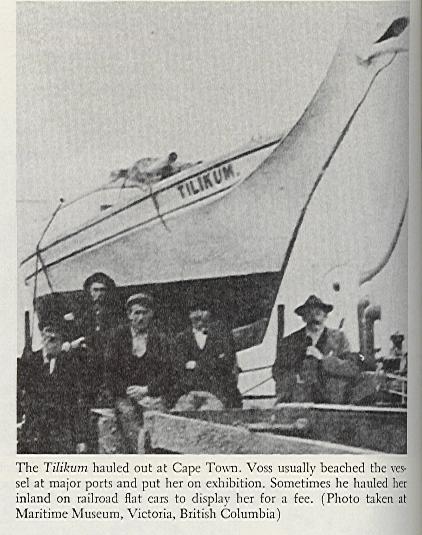
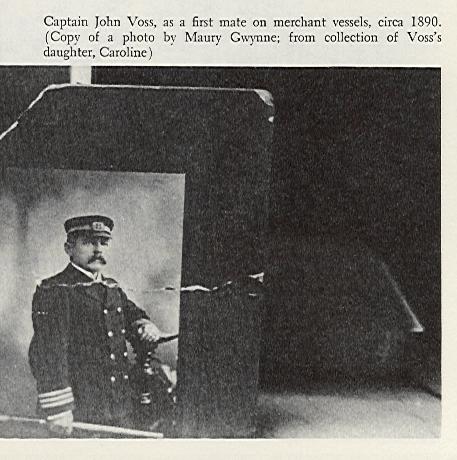
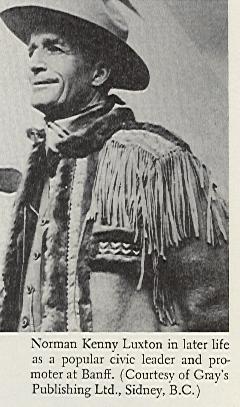
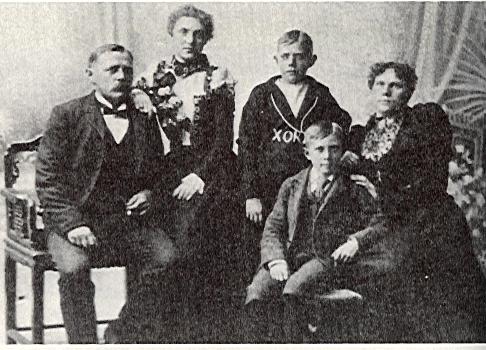
On board this bizarre vessel was perhaps the most unlikely pair ever to embark on such an adventure: Norman Kenny Luxton, in his twenties, but already with a colorful career behind him, a sometime newspaperman and promoter, slight of build, with brown hair and pale blue eyes; and Captain John (Jack) Claus Voss, a short chesty German in his middle forties, with handlebar moustache and sharp gray eyes, thin brown hair, and imperious manner, a Victoria, British Columbia, hotel keeper, sea captain, soldier of fortune, smuggler, treasure hunter, and family man. On the wharf, waving to them as they drifted slowly away with the tide and morning offshore breeze, were friends and family members of both men no doubt wondering if they would ever see either of them again. The name on the bow of this new-painted vessel was Tilikum, which was an Indian word for "friend." The name was appropriate to the tenor of the times, with the world beginning a new century bright with optimism, hope, peace, prosperity, and universal friend- ship. It was a time of great and lively interest in adventuring and exploration. The Klondike and Alaskan gold rush had reached a peak of public interest. Great fortunes were being made everywhere, it seemed, in lumbering, mining, shipping, fish packing, railroad and townsite speculation, oil, and mercantilism. The panic and depression of the late 1890s had finally been broken. It was time for daring and gambling for big stakes. Great economical and social changes were afoot. It was great to be alive and a participant and challenger in life.
The Tilikum was only one of numerous vessels in various countries
of the world that was launched, proposed, or already afloat for the
purpose of imitating or outdoing Captain Joshua Slocum and his
Spray, the fame of which had by now become worldwide, to say
nothing of profitable. Tilikum was 38 feet overall including the
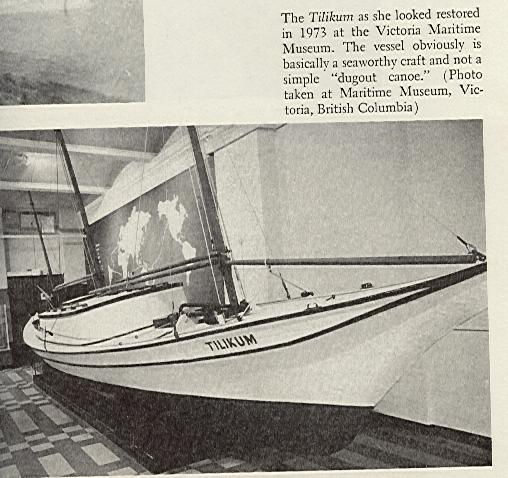
Despite outward indications, Tilikum was surprisingly seaworthy and handy, although her windward ability left room for doubt. The modifications and outfitting had been the work of Voss himself, and were the result of years of experience. Born probably in Germany in the 1850s,(2) he went to sea when he was nineteen, sailing the oceans on the tough square-riggers, did some sealing in the Bering, pros- pected for gold in Nicaragua, did a little smuggling of Chinamen into the United States, showed up at the gold-rush centers of Colorado and British Columbia, was master of several vessels, and mate of tall lumber clippers out of Puget Sound ports. He had more recently engaged in a fascinating and adventuresome expedition on the Xora, a pretty little 10-ton sloop, to the Cocos Islands and South America in search of buried treasure. From about 1895 until meeting up with Luxton in a bar, he had been a hotel owner and operator.(3) Co-owner and mate Norman Luxton had been born on November 2, 1876, at Upper Fort Garry, now Winnipeg, Manitoba, Canada, son of the founder of the Winnipeg Free Press, and at age sixteen became a clerk at the Rat Portage Indian Agency. Later he went to the Cariboo gold fields, worked on the Calgary Herald as reporter and typesetter, and migrated to Vancouver where he founded, with Frank Burd, who later owned the Province, a weekly gossip sheet. When this folded, Luxton went to work for the Vancouver Sun, and it was probably during this period when he met Jack Voss in a bar and they began to talk of ships and sea adventures and Captain Slocum's feat.
An analysis of Voss's book, The Venturesome Voyages of Captain
Voss, Luxton's posthumous journal, and independent research, how-
ever, indicates that the only difference in the degree of prevarication
and personal egotism between the two was their ages. Of the two,
Voss's written account is by far the most lucid, informative, and
On the morning they left on their circumnavigation, Luxton wrote, he learned that Voss had registered the Tilikum as the Pelican in order to confuse the U.S. Coast Guard revenue cutter that was sup- posed to be waiting to intercept Voss, who was wanted for alleged smuggling of dope and illegal Chinese labor. Luxton related how smugglers like Voss, when caught by the fuzz, would drop the Chinamen over the side in gunny sacks.(7) Seeing them off were Captain Voss's family his wife, daughter, and youngest son; Luxton's brother, George, and O. B. Ormond, proprietor of Ormond's Biscuits in Victoria. After attending an all- night dance at the Dallas Hotel, Luxton was in no shape to navigate, and as soon as they were off, went below and hit the sack. He didn't wake up until the Tilikum entered the violent rips at Race Rocks, about ten miles from Victoria. From here on, they hit head winds and had difficulty making their way out the strait, so they pulled in at Sooke Harbour and beached the boat to check on several leaks which had developed through open seams. Departing again, they attempted to double Cape Flattery but the weather again forced them to run back to shelter on the west coast of Vancouver Island. There they spent several weeks visiting with white families and the Indian villagers. At one point, Luxton related how he joined a native whaling foray offshore. At another time, he told how a friend had tried to shanghai him aboard a sealing schooner bound for the Bering. (Luxton claimed to have made several such trips and to hold a mate's ticket, a claim that cannot be substantiated by any records now extant.) In any case, they spent a leisurely few weeks exploring the west coast of the island and getting Tilikum ready again.(8) On July 6, they departed at last, bound for Pitcairn Island and the Marquesas. They had not gone more than twenty-five miles when they were surrounded by a large migration of gray whales, then common on this coast, and were in danger of being struck and crushed by the cavorting cetaceans. Down along the west coast of North America they sailed, experi- erencing fine weather and frequent gales, learning to handle the Tilikum and settling into a daily routine of sixty to seventy miles. On this leg, Captain Voss gave Luxton some of the best on board train- ing in small-boat handling under bluewater conditions ever related, and the techniques Voss described were little-known then and dec- ades ahead of the current crop of heavy weather sailing manuals. Down through the northeast trades they went, then into the dol- drums and across the equator into the South Pacific. Instead of Pitcairn or the Marquesas, they made their first landfall at Penrhyn Island on September 1. The two men had a violent argument here about landing, Voss wanting to continue on to Samoa because he feared the natives on Penrhyn would be hostile. But land here they did and found anchored the two-masted schooner Tamari Tahiti Tahiti, the French trading vessel, commanded by Captain George Dexter, a half- caste Tahitian-American, and his partner, the legendary Captain Joe Winchester, "an English gentleman and sailor," who was the father- in-law of James Norman Hall of later Mutiny on the Bounty fame. Their stay on Penrhyn was apparently an eventful one, at least for Luxton, who related that he was trapped into a marriage by the mother of a local "princess," from which he escaped only by quick thinking and a glib tongue; and on their final departure, they were attended, Voss said, by two young "princesses," who came aboard to wish them bon voyage. To nineteenth-century searovers, apparently any dusky native belle was a "princess," a bit of harmless Anglo- Saxon chauvinism which went over big with the folks back home, but which any World War II G.I. in the South Pacific Theater forty years later had another name for. The Tilikum stayed in the Cook Islands until September 25, when Voss and Luxton departed for Samoa by way of Danger Island.(9) They paused briefly here, and on the passage to Samoa trouble erupted between the two with Luxton claiming that Voss threatened to "throw him overboard." The younger man then armed himself with a .22 caliber Stevens target pistol and locked Voss in the cabin until they reached Apia. There they appeared to have patched up their differences and enjoyed a short stay and the hospitality of the local white colony and natives alike. Luxton here became involved with a Sadie Thompson with "legs like mutton and breasts like huge cabbages," who wanted him to manage her store.(9) Luxton visited the sights, including Robert Louis Stevenson's Vailima, and his tomb, wherein the famed author had inscribed his own epitaph, quoted by every voyager to visit here, ". . . Home is the sailor, home from the sea,/And the hunter home from the hill." The first week in October, Luxton said he hunted up Voss, and they got underway for Fiji. Before they left, however, Luxton took Voss to Mr. Swan's store and read to him an account of their differ- ences with a statement of Voss's threat. The paper also stated that, if Luxton went missing between Samoa and Australia, Mr. Swan was to take such action as necessary to make Voss prove he had not killed Luxton. In his journal, Luxton claimed that Voss signed the state- ment as correct, although Voss makes no mention of this, and the paper which Luxton alleges Voss signed no longer exists. On the third day out of Samoa, they sighted Niuafoo, where they were met by an island lass who swam out to beg for a plug of T and B chewing tobacco. Two days later they came to one of the Fiji islands where Luxton went ashore to explore with gun and camera while Voss tended to the ship's needs. The next day they sailed for Suva. Luxton related that while ashore he had been met by a white official on horseback who told him a permit was needed from the Tonga government to land on the island, and that the natives were inclined to find "long pig" tempting as a dietary supplement. While in these waters, the two men were threatened by natives sailing their fast catamarans, who were dissuaded from attacking when Voss fired the old Spanish cannon which they still had aboard along with the Siwash skulls they had robbed from the British Columbia Indian burial ground. Luxton had neglected to tell Voss, however, that the cannon had been unshipped at Apia, and never made fast again. The black powder recoil tore it from its block and sent it over the side, lost forever. The natives, meanwhile, had abandoned their canoes and swam ashore. The two men collected the canoes, tied them together, and sent them sailing off by themselves, an episode that sounds like it came straight out of a Grade B western, with canoes instead of Indian horses. Voss never mentioned anything about this, which Luxton explained in his narrative by saying that "Jack was afraid he might go to jail for shooting at them," and because they had also stolen some of the native paddles and weapons from the canoes.(11) It was here that Luxton (without credit) used the old "tack" trick to warn against hostile natives coming aboard at night. He claimed a George Ellis had insisted on his taking a supply of carpet tacks along to the Fijis to sprinkle on deck at night (just as Captain Slocum's friend Samblich, in Punta Arenas, had cautioned him to do when he set out to sail through Magellan Strait ) . Unlike Slocum, Luxton heard a noise in the night, rushed out on deck, and stepped on the business ends of his burglar alarm. It was during the passage from here to Suva that Luxton claimed they were shipwrecked on a reef, and that Luxton was left for dead on the beach until he came back to life again with a body full of contusions and abrasions. They stayed here several days patching the Tilikum, and then, on October 17, sighted Suva Harbor lights and were taken in tow by the port captain's launch.(l2) The stay in Suva was pleasant, and Luxton, who said the shipwreck on Duff Reef had taken his last reserve of strength, here parted company with his partner. Voss, who did not even mention the shipwreck, claimed Luxton approached him with the proposal to engage another seaman in his place, and to continue on to Sydney by steamship himself. Luxton's version was that Voss had approached him with the news that the doctor had told him that Luxton was in no condition to continue on the Tilikum and should go to Australia by steamship. Also, Voss warned, it was either that or write to Mr. Swan in Samoa, that Luxton had decided to commit suicide. Luxton did leave the Tilikum and took passage to Sydney, leaving Voss to recruit a man named Louis Begent in a Suva bar. Luxton said he tried to get Begent to throw away the Tilikum's liquor supply before they departed, and warned him about Voss, to no avail. During the passage, Voss claimed Begent was washed overboard in a storm. In his private correspondence, Luxton later said he felt sure that Voss killed Begent in a drunken fight and threw him overboard. He also claimed that Voss did not deny this when Luxton accused him of it. While he was convalescing in Sydney, Luxton primed the newspapers to expect Voss and the Tilikum (and no doubt share the publicity with him). When Voss finally landed, days overdue and Begent missing, the papers had an even better story. Luxton said Voss was in the hospital for weeks suffering from exposure and "sick- ness he contracted through the women on the islands" (those "prin- cesses," no doubt). After making numerous appearances together in Australia, the two erstwhile adventurers parted company in Melbourne. Luxton had an extended stay in Australia, and fortunately being a fair photographer even in that day and with the equipment he carried with him, he left a remarkable record of their ports of call and life aboard the Tilikum which did not come to light until his journal was published in 1971. Although he claimed he still owned two-thirds of one-half of the Tilikum, and all the rights to subsequent published works, he never pressed his claims, and was even enthusiastic about Voss's later book, which he recommended highly for its value as a sailing manual for small vessels. Luxton never saw Voss again, and returning to Canada, married, and founded a tourist haberdashery, trading post, and taxidermist shop in Banff, which he called "The Sign of the Goat Trading Post." He also bought and published Banff's first newspaper, the Crag and Canyon, and as early as 1906 established himself as a publicist and promoter of Banff as a Canadian Switzerland. For the next half- century, until he died October 26, 1962, Norman Kenny Luxton was a familiar sight in the growing little tourist center of Banff, usually dressed gaily in his buckskin clothes and wearing a ten-gallon hat. He received many civic honors in his active life, including the title of Chief White Eagle from the Blackfeet Indians for his support of the IndiAn Association and his efforts in founding the Banff Indian Days annual celebration. He married his "princess," daughter of David McDougall, a pioneer rancher and trader, who was the first white child born in what is now Alberta. As far as is known, Luxton never even saw the ocean again and never discussed in public his adventure with Captain Voss. In his journal, written for his daughter, Eleanor Georgina, he claimed that a spiri- tualist, whom he consulted before he left Australia, described to him exactly what happened that night when Voss allegedly had a drunken fight with Louis Begent and threw him overboard. Until his death, Luxton also firmly believed that Voss was lost at sea during his Japa- nese adventures. Meanwhile, however, Captain John Claus Voss, whom we left alive and well in Australia, had a different story to tell. He said that upon arrival he looked up Luxton, who had given him up for lost. Luxton was distraught about the loss of Begent and blamed himself for leaving the Tilikum. Voss called Luxton a good shipmate and a careful sailor. "I am quite sure that had he remained on the vessel in Suva and made the trip with me to Sydney, the accident would not have happened. I therefore urged him to continue the voyage to Europe, but in spite of all my pleadings he refused to go on, and so I became the sole owner of the Tilikum and all her fittings.''(l8) Voss's version of the spiritualist was that Luxton had engaged her and she had warned him the Tilikum would be damaged before he left Australia. The vessel was placed on display by Voss, along with the British Columbia Indian artifacts which were still with them, and taken on tour of various cities to earn money for the voyage. At one point, Tilikum was dropped by a carrier while being moved and Voss sued the company for damages.(l4) He also recruited another mate for the next leg of the voyage, one of many male and female applicants, and the first of several before the voyaging was done with. After numerous adventures, Voss sailed to Hobart, Tasmania (as Slocum had), where one of his greeters was the sister of Louis Begent, whom he reported, bore him no ill will. New Zealand was the next stop of the Tilikum, and a fine welcome was had. There he participated with the vessel in local celebrations which included an exhibition of running the surf to the delight of spectators, and for which he was paid £50. After a lecture tour and many fetes, the captain departed New Zealand August 17, 1902, with MacMillan, a well-educated man of refined manners, for the New Hebrides and the Great Barrier Reef. They explored through Torres Strait and into the Indian Ocean, sailed to the Keeling-Cocos Islands, Rodriguez, and Durban with many adventures.(15) A long stay was made in South Africa, and in Johannesburg he ran into an old fortune-hunting buddy from Xora days, now married and with a beautiful home, a wife, and two sweet young children. "Mac" was still chasing rainbows, and in Africa he was on the trail of gold and diamonds. Captain Voss found Johannesburg, at six hundred miles from the ocean, too far from salt water, and soon departed. In Pretoria, Tilikum was damaged,(16) several old friends from Victoria showed up, and a new mate was signed on. The next stop was St. Helena, and then course was shaped for Pernambuco on the Brazilian bulge, which Voss had not visited since 1877 when he was on his first voyage to sea in a 300-ton sailing ship out of Hamburg, Germany, bound for Guayaquil, Ecuador. They remained two weeks in Pernambuco, and on June 4, at 3 P.M., they were towed to sea and the long sail uphill to London by way of the Azores began.(l7) On August 29, Tilikum was tacking off the Cape Lizard light. On September 2, at 4 P.M., the jetty at Margate was rounded, and thousands of people lined up to watch. From the distance came a voice: "Where are you from?" "Victoria, British Columbia." 'How long have you been on this voyage?" "Three years, three months, and twelve days." Then a great cheer went up from the crowd. In England, Captain Voss was lionized and idolized. Twice he was nominated for a Fellowship in the Royal Geographical Society although for unknown reasons he was never elected nor ever officially became a member.(18) Other adventures followed, including a spell on the Japanese seal- ing schooner Chichishima Maru, and a subsequent voyage on the Sea Queen, a Thomas Fleming Day Sea Bird-type, built by two young men, F. Stone and S. A. Vincent of the Yokohama Yacht Club. On July 27, 1912, they put to sea in the Sea Queen, on a planned world cruise which terminated in a typhoon and a limp back to port a month later under jury rig.(l9)
The Tilikum? After she arrived in England on September 2, 1904, she was exhibited for a time, and then left to rot on the Thames mud flats for twenty years or so. In 1928, a group of British naval officers found the derelict ship with the help of the National Museum at Greenwich, the Victoria Publicity Bureau, and various yachting magazines. The canoe was then in the possession of two brothers, E. W. and A. Bydord, who agreed to give it to Victoria on the condi- tion that Tilikum never be exhibited for financial gain. She was trans- ported to British Columbia and restored by the Thermopylae Club and public donations. Since June 8, 1965, Tilikum has been on display at the Maritime Museum in Victoria. The figurehead, which had been damaged by a kick from a horse in Pretoria, has been restored, as have other parts, exactly the way it was when Voss and Luxton sailed her.
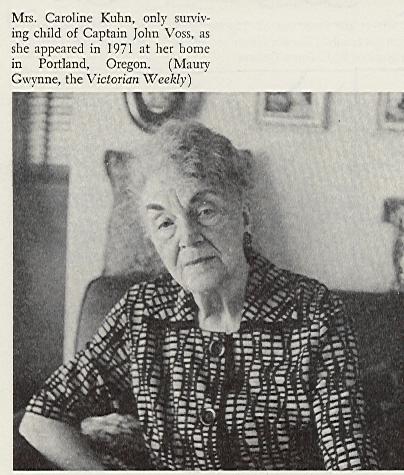
"The last time I saw him before he died in Tracy, California, we talked a lot. He was always laughing." Her father, she said, loved the sea and always believed he would never drown. He was a restless man, always on the go, and he had made a lot of money in the hotel business. Caroline, the oldest of three children, could not remember how she came to be born inland at Denver, Colorado, but at this period Voss had been following the gold fever and no doubt it was for business reasons. Caroline grew up in Victoria, where her father owned and oper- ated at least two hotels, the Queen's and the Victoria. "It was during the gold rush and father did very well." She thinks her father financed the Tilikum venture, not Luxton. Before he left, her father told her that, if she had been a boy, he would have taken her along. He did not, however, indicate that he wanted to take either of his two sons. From Australia, he sent for his wife. Caroline remembers her mother "dropped her off in Portland" on the way, where she has made her home ever since. After Voss returned from his sea adventures, he bought another hotel in Victoria and brought Caroline up from Portland for the grand opening. This was before she married, and her father gave her a lot of money, she said, "to buy all the clothes I needed." Later Voss moved to Tracy, California, where he had relatives. Caroline believed it was because of a pending divorce. Her mother followed him to California, but later returned and divorced him. Her father, Caroline said, was very bitter about this. Voss never went back to the Pacific Northwest. He bought a Ford and started a jitney service a sort of mini-bus type of operation, common to West Coast cities in those days. He was in his eighties, she thinks, when he died.(21) She had not read Luxton's journal, but defended her father vigor- ously. "Anyone who knew him would never believe those things about him. He was very kind to us, and everyone liked him. He was a good man who could not get over his love for the sea." And so Captain John Claus Voss passes into a kind of immortality, along with the man he tried to surpass, Captain Joshua Slocum. A man inclined to braggadocio perhaps, and even to prevarication, but he was a master of the sea and its moods and of small vessels that challenge it perhaps one of the greatest seamen of all time. For half a century, he has been a mysterious, controversial character, and his techniques have been belittled and disparaged by some of the best- known bluewater sailors. But they invariably were given to superficial conclusions. An innovator and experimenter, a resourceful and courageous man, his greatest fault seems to have been the inability to sell himself convincingly. He was a man of action, not of words. - end Chapter 2 -
AUTHOR's NOTES Chapter Two 
|